Introduction: Building B2B Growth Systems for 2026 and Beyond
B2B marketing is entering its most decisive phase.
In 2026, businesses are no longer competing only on product capability or pricing efficiency. They are competing on clarity, credibility, and system maturity. Buyers are better informed, decision cycles are longer, and trust is formed long before the first sales conversation begins. At the same time, the cost of attention has increased sharply across digital channels, making inefficient marketing not just ineffective—but dangerous to long-term growth.
This shift has created a widening gap between companies that treat marketing as a growth system and those that still treat it as a campaign function.
The 2026 B2B Performance Marketing Blueprint is written to address this exact gap.
This article introduces a structured, execution-ready framework that helps B2B companies move from market research to revenue scale using a clear, logical progression. It combines classical marketing foundations with modern performance execution, AI-led insights, and brand-led trust systems. The objective is not to add more tactics to your stack, but to help you design a marketing engine that compounds over time.
Why B2B Marketing Requires a Blueprint in 2026
Most B2B organizations today are not short on tools. They have access to advanced ad platforms, CRM systems, automation software, analytics dashboards, and AI assistants. Yet despite this abundance, many struggle with inconsistent pipelines, rising customer acquisition costs, low-quality leads, and weak brand recall.
The reason is structural, not tactical.
Marketing efforts are often fragmented across channels, teams, and objectives. SEO operates in isolation. Paid media is judged on CPL alone. Content exists without distribution. Branding is treated as a creative exercise rather than a revenue lever. Sales and marketing operate with different definitions of success.
In 2026, this fragmentation directly limits growth.
High-performing B2B companies are shifting away from disconnected execution and toward integrated performance systems—where every activity serves a clear business outcome, and every channel reinforces the others.
This blueprint exists to help you make that shift deliberately.
From Activities to Architecture
One of the biggest misconceptions in B2B marketing is that growth comes from doing more: more campaigns, more platforms, more content, more spend.
In reality, sustainable growth comes from better architecture.
Architecture means:
- Understanding the market before messaging
- Establishing positioning before promotion
- Building proof before scale
- Designing systems before chasing volume
This blueprint treats marketing as a business design discipline, not a collection of promotional activities. It focuses on how decisions made at the research and positioning stage directly impact acquisition efficiency, sales velocity, and long-term revenue.
The Marketing Quadrant Framework: A Systems View of Growth
At the center of this blueprint is the Marketing Quadrant Framework—a model designed to help B2B leaders visualize and build marketing systems that scale predictably.
Rather than viewing marketing through a linear funnel or channel-based lens, the quadrant approach organizes growth into four interdependent pillars:
- Market Foundation – Research, positioning, pricing, and distribution clarity
- Growth Engine – People and process that drive consistent demand
- Trust & Authority – Proof, credibility, and narrative leadership
- Scale & Sustainability – Partnerships, retention, and long-term leverage
Each quadrant is essential. Strength in one cannot compensate for weakness in another. When all four are aligned, marketing shifts from reactive execution to proactive growth.
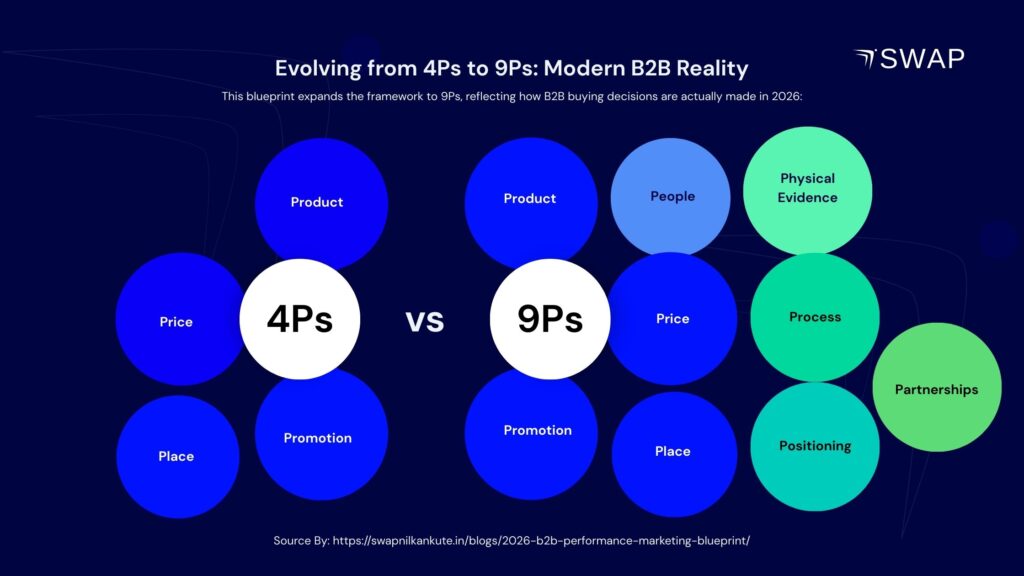
Evolving from 4Ps to 9Ps: Modern B2B Reality
Traditional marketing education is built on the 4Ps: Product, Price, Place, and Promotion. While these remain foundational, they are no longer sufficient for modern B2B environments where decisions involve multiple stakeholders, extended evaluation cycles, and high perceived risk.
This blueprint expands the framework to 9Ps, reflecting how B2B buying decisions are actually made in 2026:
- Product → Problem–Solution Fit
- Price → Value-Based Growth
- Place → Omnichannel Distribution
- Promotion → Performance + Brand Systems
- People → Trust Builders and Leadership
- Process → Revenue and Automation Systems
- Physical Evidence → Proof and Validation
- Positioning → Category and Narrative Control
- Partnerships → Scalable Growth Multipliers
The Marketing Quadrant Framework organizes these nine elements into a structure that teams can implement step by step, without losing strategic alignment.
Performance Marketing Reframed
In 2026, performance marketing is no longer about optimizing clicks, impressions, or even cost per lead in isolation.
True performance marketing answers bigger questions:
- Is marketing creating sales confidence?
- Is it shortening decision cycles?
- Is it improving deal quality and lifetime value?
- Is it building long-term brand equity alongside short-term revenue?
This blueprint reframes performance marketing as a revenue-aligned growth function—one that connects data, creativity, AI, and human judgment into a unified system.
Who This Blueprint Is For
This article is written for:
- B2B founders preparing to scale
- CXOs responsible for revenue and growth
- Marketing leaders seeking clarity beyond channels
- SaaS and service businesses facing rising acquisition costs
- Organizations transitioning from early traction to structured growth
If your goal is predictable, scalable, and defensible revenue growth, this blueprint is designed to guide your decisions.
Author Perspective
This framework is informed by over 13 years of hands-on experience working with startups, SaaS companies, enterprises, and growth-focused brands across India and global markets.
As a Performance Marketing Strategist and Growth Advisor, my work focuses on building AI-assisted, data-driven marketing systems that convert attention into measurable, sustainable revenue.
Rather than chasing short-term tactics, this blueprint reflects a long-term philosophy: growth is a system, and systems outperform campaigns.

How to Use This Blueprint
Each section that follows builds logically on the previous one, starting with market research and moving toward revenue scale. The intent is not just to inform, but to enable execution.
This introduction sets the foundation. The next section will examine why B2B marketing requires a fundamental reset in 2026—and what that means for leaders responsible for growth.
1. Executive Context: Why B2B Marketing Needs a Reset in 2026
In early 2026, I had a conversation with a founder that perfectly summarized the current state of B2B marketing.
He said, “Swapnil, our marketing numbers look good on paper. Traffic is up. Leads are coming in. But revenue feels harder than ever.”
This is not an isolated problem. It is a pattern.
Across SaaS companies, service firms, and B2B enterprises, marketing dashboards are full—but pipelines feel fragile. Campaigns are running, tools are stacked, and yet growth lacks predictability. What has changed is not effort. What has changed is buyer behavior.
This is why B2B marketing needs a fundamental reset in 2026.
The Silent Shift in B2B Buying Behavior
B2B buying today happens quietly, long before a sales call is booked.
Decision-makers now spend weeks—sometimes months—researching independently. They read articles, watch videos, compare alternatives, evaluate social proof, and increasingly rely on AI-led search and recommendations to shape their shortlists.
By the time a lead enters your CRM, the real decision is often already halfway made.
Three structural shifts define this new behavior:
- Longer decision cycles driven by higher risk awareness and internal approvals
- AI-led research replacing traditional search and manual comparison
- Trust-first evaluation, where credibility outweighs claims
In this environment, visibility alone is not enough. If your marketing does not educate, reassure, and reduce perceived risk, it fails—regardless of how many leads it generates.
Why “Leads” No Longer Equal Growth
For years, B2B marketing success was measured by lead volume.
More leads meant more opportunity. More opportunity meant more revenue.
That equation no longer holds.
In 2026, leads without context, intent, or trust create operational noise. Sales teams spend time qualifying instead of closing. CAC increases while conversion rates stagnate. Marketing and sales blame each other, and leadership questions the value of marketing investment.
The problem is not lead generation. The problem is misaligned growth metrics.
Modern B2B growth depends on:
- Demand quality, not volume
- Sales confidence, not click-through rates
- Lifetime value, not short-term acquisition
This is where traditional campaign thinking breaks down.
From Campaign Marketing to Growth Systems
Campaigns are temporary. Growth systems compound.
Most B2B companies still operate in campaign mode—launching ads, publishing content, running short-term initiatives, and then moving on to the next idea.
In contrast, high-growth organizations design systems:
- Systems that continuously attract the right audience
- Systems that educate buyers before sales engagement
- Systems that build trust at scale
- Systems that align marketing with revenue outcomes
In 2026, marketing is no longer a support function. It is an operating system for growth.
This shift—from campaigns to systems—is the defining difference between companies that struggle with volatility and those that scale predictably.
The New Role of Performance Marketers in 2026
This reset also redefines the role of performance marketers.
In the past, performance marketing was often limited to traffic acquisition and cost optimization. Marketers were evaluated on CPL, ROAS, and short-term efficiency.
In 2026, that definition is incomplete.
2. Market Research: The Foundation of Every High-Growth B2B Company
(Where serious growth actually begins)
Every B2B growth story I have been part of — whether it scaled cleanly or collapsed under pressure — can be traced back to one moment: how the market was understood before money was spent.
Not campaigns.
Not channels.
Not creatives.
Market research.
In 2026, market research is no longer a preparatory step. It is a continuous growth discipline. The companies that treat it as a one-time document struggle with wasted budgets, confused pipelines, and “good leads that never close.” The companies that embed it into their marketing systems build predictable revenue engines.
This is where the real journey begins.
2.1 ICP Research: Not Just Demographics
Most B2B companies believe they know their Ideal Customer Profile. In reality, what they know is a surface-level sketch, not a buying reality.
Revenue does not come from industries or company sizes.
It comes from decision-making behavior under pressure.
That is why modern ICP analysis must operate on three layers.
Firmographics: The Entry Filter, Not the Truth
Firmographics answer who can buy, not who will buy.
Company size, revenue, industry, geography — these are table stakes. They help eliminate poor-fit accounts, but they do not explain buying urgency, risk tolerance, or internal alignment.
Relying only on firmographics is why many B2B pipelines look full but remain fragile.
Technographics: The Hidden Signal of Readiness
Technographics reveal how mature a company already is.
The tools a business uses — CRM, analytics stack, ad platforms, cloud infrastructure — quietly expose:
-
Budget sophistication
-
Process maturity
-
Integration readiness
A company using spreadsheets and manual workflows requires education-first selling.
A company running Salesforce, HubSpot, and data warehouses expects precision.
Ignoring technographics leads to mismatched messaging and unrealistic expectations on both sides.
Intent Data: Where Timing Becomes Visible
Intent data is where ICP research becomes predictive.
Search behavior, content consumption, comparison activity, and category exploration indicate when a company is thinking, not just who they are.
In 2026, performance marketing without intent data is guesswork.
High-growth B2B companies prioritize accounts that:
-
Are actively researching problems
-
Are evaluating alternatives
-
Are consuming category-level content
This is where buyer persona research moves from theory to revenue leverage.
Buyer Committee Mapping: Selling to Systems, Not Individuals
B2B decisions are rarely personal. They are organizational negotiations.
A CEO evaluates risk and long-term leverage.
A CMO evaluates growth impact and brand credibility.
A CTO evaluates integration, security, and scalability.
Procurement evaluates cost, contracts, and compliance.
If your marketing speaks to only one of them, your sales cycle stalls.
Buyer committee mapping identifies:
-
Who initiates interest
-
Who validates the solution
-
Who blocks risk
-
Who signs approval
High-growth B2B companies design parallel messaging streams, not single narratives. Each stakeholder sees a different version of value — aligned, but role-specific.
This is why performance marketers in 2026 think in account journeys, not funnel steps.
Jobs-to-Be-Done: The Real Reason Buyers Move
People do not buy products.
They hire solutions to make progress.
The Jobs-to-Be-Done framework reframes ICP research around one core question:
What problem becomes intolerable enough to force change?
In B2B, that “job” is rarely functional alone. It includes:
-
Emotional relief (reducing pressure or uncertainty)
-
Social validation (defending decisions internally)
-
Strategic progress (future-proofing the business)
When marketing addresses features instead of jobs, it attracts interest — not commitment.
Companies that align messaging with jobs-to-be-done shorten sales cycles because buyers feel understood, not sold to.
2.2 Market Demand Analysis: Knowing When the Market Is Ready
Not every market wants education.
Not every market wants comparison.
Not every market wants innovation.
Understanding market demand stages prevents premature scaling.
Problem-Aware Markets
These buyers know something is wrong but do not know what to buy yet.
They respond to:
-
Insight-led content
-
Diagnostic frameworks
-
Educational narratives
Selling too early here feels aggressive.
Solution-Aware Markets
These buyers understand possible solutions but are evaluating approaches.
They respond to:
-
Use cases
-
Benchmarks
-
Methodologies
This is where positioning begins to matter deeply.
Product-Aware Markets
These buyers are comparing vendors.
They respond to:
-
Proof
-
Differentiation
-
ROI clarity
Performance marketing works best when messaging matches awareness reality, not internal ambition.
Demand Maturity Scoring: Predicting Conversion Probability
Demand maturity scoring combines:
-
Awareness stage
-
Buying urgency
-
Organizational readiness
It helps prioritize markets that convert now versus markets that need nurturing.
In 2026, smart B2B companies allocate budgets based on conversion probability, not audience size.
This is how marketing becomes a capital allocation function, not a creative expense.
TAM, SAM, SOM: Strategic Restraint Creates Scale
Total Addressable Market (TAM) excites investors.
Serviceable Available Market (SAM) shapes strategy.
Serviceable Obtainable Market (SOM) drives execution.
Most B2B companies fail by chasing TAM fantasies instead of SOM realities.
High-growth teams:
-
Define TAM to understand opportunity
-
Focus SAM to design relevance
-
Execute SOM to generate revenue
Clarity here prevents overextension and keeps growth controlled.
2.3 Competitive Intelligence: Understanding the Battlefield
Competitor analysis in B2B is not about copying.
It is about seeing what the market has normalized.
Category Leaders vs Price Players
Category leaders sell outcomes and authority.
Price players sell urgency and discounts.
Knowing where competitors sit reveals:
-
What the market already expects
-
What messages are overused
-
Where differentiation is possible
Trying to outspend leaders or undercut price players is a losing strategy.
Messaging Gaps in Ads and Content
Most competitor ads repeat the same promises:
-
Faster
-
Cheaper
-
Smarter
Messaging gaps appear where competitors avoid clarity — pricing logic, implementation reality, trade-offs.
That is where trust is built.
SEO + Paid Gap Analysis
SEO reveals long-term intent patterns.
Paid search reveals immediate demand pressure.
Analyzing both together shows:
-
What competitors want today
-
What they are afraid to commit to long-term
This dual lens is essential for modern competitor analysis B2B.
Why Market Research Determines Growth Velocity
In 2026, performance marketing is no longer about finding traffic.
It is about aligning capital with certainty.
Market research creates that certainty.
When ICPs are clear, demand is understood, and competitors are decoded, marketing stops being reactive. It becomes a revenue architecture — designed, intentional, and scalable.
This is the foundation every high-growth B2B company must build before moving to positioning, pricing, and channels.
Because growth does not fail at scale.
It fails at understanding.
3. Positioning Strategy: From Product to Problem–Solution Fit (P1)
Most B2B products do not fail because they are weak.
They fail because the market never understands why they exist.
I have seen technically strong platforms struggle for years, while simpler solutions scale rapidly. The difference is not innovation. It is positioning clarity.
In 2026, B2B positioning is no longer about being “better.”
It is about being unavoidable at the exact moment a problem becomes expensive.
That is what modern product positioning means.
Why Features Do Not Sell in B2B
Features feel safe. They are measurable, defensible, and easy to explain internally.
But buyers do not make decisions based on features — they make decisions based on risk and consequence.
A CTO does not buy a tool for its dashboard.
A CMO does not approve software because it has integrations.
A CEO does not sign contracts because of roadmaps.
They buy to:
-
Reduce uncertainty
-
Avoid future regret
-
Create strategic advantage
Features describe what a product does.
Positioning explains why choosing it makes sense now.
When marketing leads with features, it shifts cognitive effort to the buyer. In complex B2B environments, that friction delays decisions.
High-growth companies remove that friction by translating products into outcomes.
Translating Offerings into Outcomes
Every product lives in two worlds:
-
The internal world of capabilities
-
The external world of consequences
Performance marketing bridges this gap.
An outcome is not a benefit.
It is a measurable change in business reality.
For example:
-
Not “AI-powered analytics”
-
But “earlier visibility into revenue risk”
-
Not “automated workflows”
-
But “fewer human errors during scale”
When outcomes are clear, stakeholders can defend decisions internally. That is why outcomes accelerate deals.
Strong B2B product positioning reframes the product as a business lever, not a tool.
Use-Case Based Positioning: How Buyers Actually Think
B2B buyers rarely ask, “Which product is best?”
They ask, “Will this work in our situation?”
Use-case based positioning aligns messaging with:
-
Company stage
-
Industry constraints
-
Operational complexity
A startup scaling from 10 to 50 employees has a different risk profile than an enterprise optimizing margins.
By positioning the same product across multiple use cases, companies:
-
Expand relevance without diluting focus
-
Shorten discovery cycles
-
Reduce objection friction
This approach respects the buyer’s context instead of forcing a generic narrative.
Industry-Specific Landing Pages: Precision Over Reach
In 2026, generic landing pages signal laziness.
Industry-specific landing pages show:
-
Understanding
-
Experience
-
Confidence
They answer unspoken questions:
-
“Have you solved this problem before?”
-
“Do you understand our constraints?”
-
“Will this integrate into our world?”
Effective industry pages focus on:
-
One dominant problem
-
One clear outcome
-
One relevant proof point
This structure turns traffic into qualified conversations.
From a performance perspective, industry pages:
-
Improve Quality Scores
-
Increase conversion intent
-
Reduce sales qualification time
This is how problem–solution fit becomes visible before a sales call.

The Positioning Framework That Scales
Over time, one pattern consistently outperforms feature-based messaging. It is simple, but not easy to execute.
Problem → Cost of Inaction → Outcome → Proof
Problem
State the problem the buyer already feels but may not articulate clearly. Precision matters more than drama.
Cost of Inaction
Expose the hidden cost of doing nothing:
-
Revenue leakage
-
Operational drag
-
Competitive disadvantage
This is where urgency is created ethically.
Outcome
Define the future state clearly and measurably. Outcomes must be believable, not aspirational.
Proof
Proof reduces perceived risk:
-
Case studies
-
Benchmarks
-
Data points
-
Authority signals
When proof is strong, sales resistance weakens naturally.
This framework aligns marketing, sales, and leadership around the same narrative.
Value Proposition in 2026: Clarity Beats Cleverness
A strong B2B value proposition is not a slogan.
It is a decision filter.
It helps buyers quickly answer:
-
Is this relevant to me?
-
Is this credible?
-
Is this worth my attention now?
The best value propositions are not creative. They are clear.
They sacrifice clever language to remove doubt.
In a world of AI-generated noise, clarity is the new premium.
Positioning Is a Growth Multiplier
Positioning is not a branding exercise.
It is a performance lever.
Clear positioning:
-
Improves paid campaign efficiency
-
Increases organic relevance
-
Shortens sales cycles
-
Raises deal confidence
When positioning is weak, every channel works harder to compensate. When positioning is strong, channels amplify instead of struggle.
This is why positioning comes before promotion in modern marketing systems.
From Product to Revenue Narrative
In 2026, performance marketers are not traffic operators.
They are narrative architects.
Their role is to ensure that when a buyer encounters a product — through ads, content, or sales — the message aligns perfectly with:
-
The problem they feel
-
The cost they fear
-
The outcome they want
-
The proof they need
That alignment is what turns interest into commitment.
Positioning is the first “P” of the modern marketing mix because without it, every other lever underperforms.
Once the product is positioned around problems and outcomes, the next challenge becomes pricing, value anchoring, and monetization strategy — where growth either compounds or collapses.
That is where the next layer begins.
4. Pricing Strategy: Value-Based Growth, Not Discounting (P2)
Pricing is where most B2B growth stories quietly break.
Not because the product is overpriced.
Not because the market is unwilling to pay.
But because pricing is treated as a financial decision, not a strategic signal.
In 2026, pricing communicates far more than cost. It signals confidence, maturity, and the level of transformation a buyer should expect. When pricing is misaligned, even strong positioning collapses into negotiation loops and margin erosion.
High-growth B2B companies understand one truth early:
pricing does not follow value — it defines it.
Cost-Plus Pricing vs Value-Based Pricing
Cost-plus pricing feels logical. You calculate expenses, add a margin, and arrive at a number that feels safe. Internally, it is easy to defend. Externally, it is meaningless.
Buyers do not care what it costs you to build a solution.
They care what it costs them to delay, fail, or choose incorrectly.
Value-based pricing reverses the logic:
-
What problem does this solve?
-
What risk does it reduce?
-
What upside does it unlock?
When pricing reflects economic impact, conversations move away from discounts and toward justification.
In 2026, value-based pricing B2B is not premium pricing. It is honest pricing.
Why Discounting Damages Long-Term Growth
Discounting does not accelerate trust. It accelerates doubt.
When discounts appear early in the sales process, buyers subconsciously ask:
-
Why is this negotiable?
-
Is this solution really worth its list price?
-
What risk am I being compensated for?
Discounting trains the market to wait, hesitate, and negotiate. Over time, it attracts price-sensitive buyers who churn faster and demand more support.
High-growth B2B companies protect pricing not out of ego, but out of strategic discipline.
They adjust scope, timelines, or outcomes — not perceived value.
Pricing Psychology in B2B Decision-Making
B2B pricing decisions are rational on the surface and emotional underneath.
Executives want:
-
Predictability
-
Defensibility
-
Internal alignment
Good pricing reduces psychological friction by making decisions easier to explain inside the organization.
Key principles that matter in 2026:
Anchoring:
The first number sets the perception of value. Strong anchors frame everything that follows.
Contrast:
Tiered pricing makes mid-options feel safe and reasonable.
Risk Reversal:
Clear onboarding, milestones, and success metrics reduce fear of commitment.
Pricing that ignores psychology invites hesitation. Pricing that respects it accelerates consensus.
ROI Storytelling: Turning Price into Investment
Price resistance is rarely about money.
It is about uncertainty.
ROI storytelling bridges that gap.
Instead of presenting numbers, high-performing teams present scenarios:
-
What happens if nothing changes?
-
What happens if improvement is delayed?
-
What happens when the system works as designed?
ROI storytelling connects pricing to:
-
Revenue protection
-
Cost avoidance
-
Opportunity creation
In proposals and ads, ROI is not a calculator. It is a narrative of progress.
When buyers see pricing as an investment with a visible return path, approvals move faster.
Pricing Tiers Aligned with Buyer Maturity
Not every buyer is ready for the same level of commitment.
Pricing tiers should reflect organizational maturity, not feature quantity.
Entry tiers support:
-
Early-stage teams
-
Education-first buyers
-
Validation use cases
Mid-tiers support:
-
Scaling teams
-
Process formalization
-
Measurable performance improvement
Premium tiers support:
-
Transformation
-
Customization
-
Strategic partnerships
This structure allows growth without forcing premature decisions.
In 2026, smart B2B pricing strategy is not about upselling. It is about meeting buyers where they are and growing with them.
Pricing as a Growth Filter
Pricing does more than generate revenue.
It filters demand.
Underpriced offerings attract misaligned buyers.
Correctly priced offerings attract serious partners.
High-growth B2B companies intentionally use pricing to:
-
Reduce churn
-
Improve sales efficiency
-
Increase lifetime value
This is why pricing must be integrated with positioning, marketing, and sales — not handled in isolation.
Ads and Pricing: What to Show, What to Signal
In 2026, transparency builds trust — but full disclosure is not always strategic.
Performance marketers understand:
-
When to show price
-
When to signal value
-
When to qualify before revealing numbers
Ads that communicate outcomes and proof before price generate higher-intent traffic. Ads that lead with discounts attract low-commitment behavior.
Pricing language in ads should:
-
Reinforce confidence
-
Signal seriousness
-
Align with brand maturity
Price is not a hook. Value is.
From Pricing to Profitability
Pricing determines:
-
Sales behavior
-
Marketing efficiency
-
Customer expectations
When pricing aligns with value, everything downstream improves:
-
Fewer negotiations
-
Higher trust
-
Stronger retention
In B2B pricing strategy 2026, growth does not come from being cheaper. It comes from being clearer, braver, and more disciplined.
Pricing is not the second “P” by accident.
It is the moment where strategy becomes commercial reality.
Once pricing reflects value, the next challenge is distribution and demand capture — choosing the right channels, ecosystems, and touchpoints to reach buyers when intent peaks.
That is where the next layer of the blueprint unfolds.
5. Distribution Strategy: Where B2B Demand Actually Lives (P3)
Most B2B companies do not have a demand problem.
They have a distribution blindness problem.
They invest heavily in products, positioning, and pricing — then hope the market will “discover” them through isolated campaigns. In reality, demand already exists. It is simply fragmented across platforms, moments, and mindsets.
In 2026, distribution is not about being everywhere.
It is about being present at the exact point where intent surfaces.
That is what modern B2B distribution strategy means.
Search Intent Ecosystems: Demand Reveals Itself Quietly
Search is no longer a single channel. It is an ecosystem.
Google Search captures explicit intent.
YouTube captures learning intent.
AI search captures exploratory and comparative intent.
Together, they form a buyer intelligence layer.
When a buyer searches, they are not browsing. They are problem-solving. Each query represents:
-
Urgency
-
Context
-
Readiness
High-growth B2B companies design content and ads around intent clusters, not keywords alone.
They understand that:
-
Early searches seek clarity
-
Mid-stage searches seek validation
-
Late-stage searches seek proof
Ignoring this progression leads to mismatched messaging and wasted spend.
In 2026, search is not about rankings.
It is about being useful at the moment of uncertainty.
YouTube: The Underestimated B2B Trust Engine
YouTube is no longer a brand-awareness channel.
It is where complex B2B decisions are quietly researched.
Buyers use video to:
-
Understand unfamiliar categories
-
Evaluate credibility
-
Reduce perceived risk
A short-form ad introduces relevance.
A long-form video builds authority.
Together, they create asymmetric trust — the buyer feels informed before any sales interaction.
Performance marketers who treat YouTube as a performance channel, not a creative playground, unlock:
-
Higher-quality leads
-
Shorter sales cycles
-
Better-informed prospects
Video does not replace sales.
It prepares buyers to say yes.
AI Search: The New Discovery Layer
AI-driven search experiences change how buyers discover solutions.
Instead of browsing pages, buyers now:
-
Ask questions
-
Compare approaches
-
Seek synthesized recommendations
This shifts distribution strategy from visibility to interpretability.
Brands that:
-
Publish structured insights
-
Offer clear frameworks
-
Demonstrate authority
are surfaced more often by AI systems.
In 2026, distribution includes how well your thinking can be understood and summarized, not just indexed.
LinkedIn: From Networking to Demand Creation
LinkedIn is often misunderstood.
It is not a lead generation tool by default.
It is a context-building platform.
Buyers come to LinkedIn to:
-
Observe industry conversations
-
Validate credibility
-
Assess leadership thinking
When used strategically, LinkedIn becomes a demand creation engine.
Thought leadership builds familiarity.
Case-based content builds trust.
Paid amplification builds reach.
Together, they warm the market before direct selling begins.
High-growth B2B companies do not sell on LinkedIn.
They prepare the mind.
Email & CRM: The Quiet Revenue Multipliers
Email is not dead.
It is misunderstood.
In 2026, email and CRM systems are no longer communication tools. They are revenue accelerators.
Used well, they:
-
Nurture indecision
-
Reinforce positioning
-
Reduce deal friction
Modern email strategies are:
-
Behavior-triggered
-
Context-aware
-
Outcome-driven
CRM systems evolve from databases into decision engines — guiding sales on timing, messaging, and priority.
The companies that win treat CRM as a growth asset, not an administrative burden.
Marketplaces, Directories, and Partnerships
Not all demand starts with search.
Buyers often trust:
-
Industry marketplaces
-
Curated directories
-
Peer-recommended platforms
Being present in these ecosystems:
-
Signals legitimacy
-
Reduces perceived risk
-
Shortens discovery time
Partnerships extend reach without increasing spend. They borrow trust from adjacent brands and embed solutions deeper into workflows.
In 2026, partnerships are not optional.
They are distribution leverage.
Omnichannel Is Not Everywhere — It Is Connected
Many B2B companies claim omnichannel presence. Few execute omnichannel coherence.
True omnichannel B2B marketing means:
-
One narrative across touchpoints
-
One understanding of buyer stage
-
One system tracking engagement
A buyer may:
-
Discover through search
-
Validate on LinkedIn
-
Learn via video
-
Re-engage through email
-
Convert through sales
When channels work in isolation, momentum breaks. When they connect, trust compounds.
Distribution as a Competitive Advantage
Distribution is not a marketing function.
It is a strategic asset.
Companies that master distribution:
-
Lower customer acquisition costs
-
Improve lead quality
-
Increase brand defensibility
They do not chase channels.
They map buyer behavior and meet it deliberately.
In 2026, the best B2B companies win not by shouting louder — but by showing up earlier, clearer, and more consistently than competitors.
Distribution is the third “P” because it turns value into visibility and strategy into opportunity.
Once distribution is aligned, the next challenge is promotion and performance orchestration — how messaging, media, and measurement come together to drive predictable growth.
That is where execution becomes a system, not a campaign.
6. Promotion Strategy: Performance + Brand Operating System (P4)
Most B2B companies reach a plateau not because they stop marketing — but because they optimize in isolation.
They run paid ads for leads.
They publish content for visibility.
They do SEO for rankings.
Each function reports metrics. None of them own growth.
In 2026, this fragmented approach quietly fails. Growth now demands a promotion system where brand and performance reinforce each other instead of competing for budget.
That is the shift from marketing activities to a Performance + Brand Operating System.
Why Pure Performance Fails at Scale
Performance marketing works exceptionally well in the early stages. It provides fast feedback, measurable ROI, and predictable acquisition — until it doesn’t.
As scale increases:
-
Costs rise
-
Lead quality declines
-
Marginal returns shrink
This happens because performance marketing extracts demand — it does not create it.
When brand signals are weak, paid channels work harder to compensate. Eventually, optimization turns into diminishing returns.
High-growth B2B companies understand this early:
Performance without brand is a short-term tactic, not a growth strategy.
Brand as a Performance Multiplier
Brand is not awareness.
Brand is preference under uncertainty.
In B2B, where decisions are high-risk and multi-stakeholder, brand:
-
Reduces perceived risk
-
Speeds up internal approvals
-
Increases tolerance for premium pricing
When brand is strong:
-
Ads convert better
-
SEO rankings stabilize faster
-
Sales cycles shorten
Brand does not replace performance.
It amplifies it.
That is why modern B2B performance marketing integrates brand-building signals into every campaign.
SEO, AEO, and GEO in 2026
Search optimization is no longer about keywords alone.
In 2026, visibility depends on:
-
AEO (Answer Engine Optimization)
-
GEO (Generative Engine Optimization)
SEO captures structured demand.
AEO captures question-based discovery.
GEO captures AI-driven synthesis and recommendations.
Together, they determine:
-
Who appears
-
Who is quoted
-
Who is trusted
Content must now be:
-
Structured
-
Insight-led
-
Authority-driven
The goal is not traffic.
It is being the default answer.
Paid Ads: Signal Amplification, Not Lead Machines
Paid advertising has been misused.
When ads are treated as lead machines, they attract:
-
Price shoppers
-
Low-intent clicks
-
Unqualified inquiries
In 2026, paid ads work best as signal amplifiers.
They reinforce:
-
Positioning
-
Proof
-
Authority
Ads should amplify what already resonates organically — not compensate for unclear messaging.
High-performing teams use paid media to:
-
Accelerate proven narratives
-
Expand reach for validated content
-
Retarget informed prospects
Paid media does not create belief.
It magnifies it.
Content as a Pre-Sales Engine
Content is not marketing collateral.
It is silent sales support.
In B2B, content answers questions buyers hesitate to ask sales teams:
-
Implementation risk
-
Pricing logic
-
Trade-offs
-
Alternatives
When content addresses these openly, trust forms before contact.
Strong content:
-
Qualifies leads automatically
-
Reduces sales resistance
-
Aligns expectations
This is why content must be built for decision support, not vanity metrics.
In 2026, content that avoids clarity loses credibility.
Demand Generation vs Lead Generation
Lead generation focuses on volume.
Demand generation focuses on readiness.
Demand generation builds:
-
Awareness
-
Understanding
-
Preference
Only then does conversion become efficient.
This is the core of modern demand generation strategy — creating informed demand before capturing it.
Companies that invest in demand generation experience:
-
Higher-quality pipelines
-
Better close rates
-
Longer customer lifetimes
Demand generation is slower to start, but faster to scale.
Promotion as an Integrated System
Promotion is no longer a department.
It is a system of influence.
Every touchpoint should reinforce:
-
The same problem narrative
-
The same outcome promise
-
The same credibility signals
When SEO, ads, content, and brand work in harmony, growth becomes predictable.
In 2026, promotion success is not measured by channel performance — but by how quickly trust compounds across the buyer journey.
From Campaigns to Operating Systems
Campaigns spike activity.
Systems sustain growth.
The companies that win build promotion as an operating system:
-
Always-on
-
Insight-driven
-
Performance-measured
They stop asking, “Which channel works?”
They start asking, “What belief needs reinforcement next?”
That mindset shift is what separates marketing execution from marketing leadership.
Promotion is the fourth “P” because it activates everything built before it.
Once promotion becomes a system, the next frontier is process, people, and performance governance — turning marketing into a revenue engine that compounds over time.
That is where modern growth leadership truly begins.
7. The Marketing Quadrant Framework
A System for Building Predictable, Scalable B2B Growth
After working across industries, markets, and growth stages, one pattern became impossible to ignore:
B2B companies do not fail because they lack tools.
They fail because growth efforts are unbalanced.
Some over-invest in acquisition and ignore trust.
Some build strong brands but weak engines.
Some scale fast and collapse later.
What high-growth companies do differently is not intensity — it is structure.
That realization led to the Marketing Quadrant Framework — a system designed to align strategy, execution, and sustainability into one growth model.
This is not a funnel.
It is not a checklist.
It is a balance system.
Why a Quadrant Framework (Not a Funnel)
Funnels assume linear behavior.
Modern B2B growth is non-linear.
Buyers move forward, pause, re-evaluate, involve new stakeholders, and return later with higher intent. Growth, therefore, must be designed as a system of forces, not steps.
The Marketing Quadrant Framework organizes growth into four interdependent quadrants. Weakness in any one quadrant eventually limits scale.
Quadrant 1: Market Foundation
Where growth earns the right to exist
This quadrant answers one question:
Is growth built on reality or assumption?
Market Foundation includes:
-
Market research
-
ICP clarity
-
Positioning
-
Pricing logic
-
Distribution alignment
Without this quadrant, marketing becomes guesswork.
Companies often skip foundation work to move faster. What they actually do is move blindly. When results plateau, they respond with more spend instead of better understanding.
Strong foundations create:
-
Higher intent traffic
-
Faster sales cycles
-
Lower acquisition waste
Growth cannot be forced.
It must be anchored.
Quadrant 2: Growth Engine
Where execution becomes repeatable
Once foundations are clear, growth depends on execution discipline.
This quadrant is built on:
-
People
-
Process
-
Accountability
Tools do not scale growth.
Teams and systems do.
High-growth companies design growth engines that:
-
Standardize decision-making
-
Reduce dependency on individuals
-
Enable consistent experimentation
This is where marketing matures from creativity to operations.
When the growth engine is weak:
-
Campaigns depend on hero efforts
-
Knowledge stays fragmented
-
Results fluctuate
When it is strong, growth becomes predictable.
Quadrant 3: Trust & Authority
Where momentum compounds
Trust is not built after conversion.
It is built before consideration.
This quadrant focuses on:
-
Proof
-
Credibility
-
Authority signals
In B2B, trust is currency.
Buyers ask silently:
-
Who else trusts you?
-
Why should we believe you?
-
Will this decision be defensible internally?
Trust & Authority shows up through:
-
Case studies
-
Thought leadership
-
Content clarity
-
Market presence
Companies that neglect this quadrant are forced to rely on discounts and pressure. Companies that invest here close deals with less resistance.
Authority shortens distance between interest and commitment.
Quadrant 4: Scale & Sustainability
Where growth survives success
Most companies can grow once.
Very few can sustain growth.
This quadrant focuses on:
-
Partnerships
-
Retention
-
Lifetime value
-
Ecosystem thinking
Scaling acquisition without retention is growth illusion.
Sustainable B2B companies:
-
Expand through partnerships
-
Grow inside existing accounts
-
Build communities and ecosystems
They stop thinking in quarters and start thinking in cycles.
This quadrant ensures that growth does not collapse under its own weight.
How the Quadrants Work Together
The power of the Marketing Quadrant Framework is not in individual sections — it is in balance.
-
Strong foundation + weak trust = slow conversions
-
Strong engine + weak foundation = wasted spend
-
Strong trust + weak scale = growth ceiling
-
Strong scale + weak engine = operational chaos
Growth accelerates only when all four quadrants evolve together.
This is why marketing leadership in 2026 is about orchestration, not channel expertise.
Why This Framework Matters in 2026
The market has changed:
-
Buyers are more informed
-
Attention is fragmented
-
AI amplifies both good and bad strategy
Growth without structure now collapses faster than ever.
The Marketing Quadrant Framework provides:
-
Strategic clarity
-
Execution alignment
-
Long-term defensibility
It turns marketing from a cost center into a growth system.
(Visual Suggested Here)
A simple 2×2 quadrant visual:
-
X-axis: Execution → Sustainability
-
Y-axis: Foundation → Authority
Each quadrant clearly labeled with its role in growth.
This visual becomes:
-
A sales education tool
-
A client diagnostic model
-
A personal brand asset
From Framework to Leadership
Frameworks do not replace thinking.
They discipline it.
The Marketing Quadrant Framework is designed to help founders, CMOs, and growth leaders ask better questions before spending more money.
Because in 2026, growth is no longer about doing more.
It is about building systems that hold under pressure.
And that is where the next section begins — turning this framework into measurement, governance, and revenue accountability, so marketing finally earns its seat at the leadership table.
8. People Strategy: Trust Is the New Conversion Rate (P5)
At a certain stage of growth, no campaign can compensate for a lack of trust.
Budgets increase. Tools improve. Funnels are optimized.
Yet deals stall. Pipelines slow. Prospects hesitate.
The problem is rarely marketing execution.
It is human confidence.
In 2026, B2B buyers do not just evaluate companies.
They evaluate the people behind them.
That is why people strategy has become a core pillar of modern marketing systems.
Why Trust Has Replaced Attention as the Primary Currency
Attention is abundant.
Trust is scarce.
Buyers are exposed to thousands of messages every week. What breaks through is not volume — it is credibility.
Trust reduces:
-
Perceived risk
-
Internal resistance
-
Decision fatigue
In high-stakes B2B decisions, trust functions like a conversion rate multiplier. When trust is high, deals move faster, pricing resistance weakens, and retention improves.
This is the foundation of trust-based marketing.
Founder-Led Marketing: The Credibility Shortcut
Founder-led marketing is not about personal fame.
It is about borrowed certainty.
When founders communicate clearly:
-
Vision becomes tangible
-
Strategy feels intentional
-
Decisions feel safer
In B2B, buyers want to know:
-
Who is accountable?
-
Who stands behind this solution?
-
Who will still be here in three years?
Founder presence answers these questions implicitly.
That is why founder branding accelerates trust faster than logos or taglines.
Thought Leadership Is Not Content — It Is Positioning
Many brands mistake content output for thought leadership.
True B2B thought leadership:
-
Takes a clear point of view
-
Explains trade-offs honestly
-
Educates without selling
Thought leaders do not chase trends.
They interpret them.
When a founder or leader consistently explains the why behind decisions, buyers begin to trust the how.
Thought leadership creates:
-
Mental availability
-
Category authority
-
Long-term recall
It is not designed to convert today.
It is designed to be remembered when it matters.
Sales + Marketing Alignment: Trust Inside Before Trust Outside
External trust collapses when internal alignment is weak.
Buyers sense friction immediately:
-
Conflicting narratives
-
Mismatched expectations
-
Unclear ownership
That is why RevOps is not a system.
It is a culture of shared accountability.
Sales and marketing alignment ensures:
-
One definition of success
-
One understanding of buyer intent
-
One growth narrative
When teams operate in silos, trust erodes before deals close. When alignment exists, buyers experience continuity instead of confusion.
Internal Brand Ambassadors: The Invisible Trust Layer
Brands are not built by campaigns.
They are built by people who believe in the mission.
Internal brand ambassadors:
-
Speak consistently
-
Represent values authentically
-
Reinforce culture externally
In 2026, employees are:
-
Content distributors
-
Culture signals
-
Credibility amplifiers
When employees share insights, wins, and learning, the brand feels alive — not manufactured.
Trust spreads faster through people than through paid media.
Personal Brand Impact on Deal Closure
In many B2B deals, buyers already know the people involved before the first sales call.
They have:
-
Read posts
-
Watched videos
-
Consumed opinions
This familiarity changes the tone of conversations.
Instead of skepticism, there is curiosity.
Personal brands:
-
Reduce first-call friction
-
Improve response rates
-
Increase deal confidence
This is not about influencers.
It is about visible expertise.
Strong personal brands create asymmetry — buyers feel informed before engagement.
People Strategy as a Growth Asset
People strategy is often treated as HR responsibility. In reality, it is a growth accelerator.
When leadership, teams, and ambassadors align:
-
Messaging sharpens
-
Trust compounds
-
Growth stabilizes
This is why modern marketing systems include people alongside platforms and processes.
Because in 2026, the most optimized funnel still loses if buyers do not trust the people behind it.
From Conversion Rates to Confidence Rates
The future of marketing measurement includes:
-
Confidence created
-
Risk reduced
-
Belief reinforced
These metrics are harder to track — but easier to feel.
When buyers trust you, conversion becomes a consequence, not a goal.
People strategy is the fifth “P” because it humanizes everything built before it.
And once trust is established through people, the final challenge is process, governance, and long-term scale — ensuring growth survives leadership changes, market shifts, and competition.
9. Process Strategy: Building Predictable Revenue Systems (P6)
Growth without process feels exciting.
Growth with process feels inevitable.
Most B2B companies do not fail because they lack leads.
They fail because revenue depends on people, moods, and timing instead of systems.
Process strategy exists to remove randomness from growth.
In 2026, predictable revenue is not built by doing more marketing.
It is built by connecting intent, data, and action into a repeatable engine.
Why Process Is the Difference Between Momentum and Scale
Early-stage growth is driven by hustle.
Mid-stage growth is driven by systems.
Without process:
-
Lead quality fluctuates
-
Sales outcomes are inconsistent
-
Forecasts are unreliable
With process:
-
Demand flows in stages
-
Signals trigger actions
-
Revenue becomes measurable
Process strategy turns marketing into revenue operations, not creative activity.
Funnel Architecture: TOFU–MOFU–BOFU as Intent Layers
The B2B marketing funnel is no longer linear.
But it is still layered by intent.
The modern funnel is built around buyer readiness, not content types.
TOFU: Awareness with Context
Top-of-funnel is not about traffic.
It is about problem recognition.
TOFU assets answer:
-
What is changing in the market?
-
Why current approaches are failing?
-
What risks are emerging?
Effective TOFU content:
-
Builds category awareness
-
Frames the problem correctly
-
Creates mental relevance
The goal is not leads.
The goal is qualified attention.
MOFU: Education with Differentiation
Middle-of-funnel is where most B2B funnels break.
This is where buyers compare:
-
Approaches
-
Trade-offs
-
Philosophies
MOFU content must:
-
Explain how solutions work
-
Highlight decision criteria
-
Introduce your unique angle
Case studies, frameworks, and comparison content belong here — not as sales tools, but as confidence builders.
BOFU: Validation with Proof
Bottom-of-funnel is not persuasion.
It is risk removal.
BOFU assets focus on:
-
Proof of results
-
Clarity of scope
-
Confidence in execution
At this stage, buyers want certainty:
-
Will this work for us?
-
Who has done this before?
-
What happens after we say yes?
Process ensures the right signals reach BOFU at the right time.
CRM + Automation Stack: The Revenue Backbone
Marketing automation without CRM alignment creates noise.
CRM without automation creates bottlenecks.
In 2026, revenue systems are built on tight integration.
Core stack layers:
-
CRM as the source of truth
-
Marketing automation for orchestration
-
Analytics for feedback loops
The CRM is not a database.
It is a decision engine.
Every field, tag, and stage exists to inform the next action — not to collect vanity data.
Automation as Timing, Not Spam
Automation succeeds when it respects buyer timing.
Effective automation:
-
Responds to intent
-
Delivers relevance
-
Reduces friction
Poor automation:
-
Forces sequences
-
Ignores context
-
Destroys trust
The role of automation is to scale responsiveness, not volume.
Lead Scoring: From Demographics to Intent Signals
Traditional lead scoring relied on static data:
-
Job titles
-
Company size
-
Industry
In 2026, intent matters more than identity.
Modern lead scoring combines:
-
Behavioral signals (content depth, repeat visits)
-
Engagement patterns (time, frequency, sequence)
-
External intent data (search, comparison activity)
High scores do not mean “ready to buy.”
They mean ready for the next conversation.
This distinction prevents premature sales outreach — a common trust killer.
Sales and Marketing Use Scores Differently
Marketing uses lead scores to:
-
Adjust messaging
-
Trigger nurture paths
-
Allocate spend
Sales uses lead scores to:
-
Prioritize outreach
-
Personalize conversations
-
Time follow-ups
Process strategy ensures both teams interpret signals the same way.
Attribution Models: Understanding What Actually Works
Attribution is not about credit.
It is about clarity.
Single-touch models fail in B2B because decisions are multi-month and multi-channel.
Effective B2B attribution considers:
-
First interaction (problem discovery)
-
Influencing touches (education and proof)
-
Conversion trigger (final validation)
Multi-touch attribution reveals:
-
Which channels build trust
-
Which assets accelerate decisions
-
Where budgets actually create leverage
Without attribution, scaling becomes guesswork.
Attribution as a Strategy Tool
Attribution insights guide:
-
Content investment
-
Channel prioritization
-
Sales enablement
It transforms marketing from expense to infrastructure.
Revenue Operations: Where Process Becomes Culture
Revenue operations (RevOps) is not a department.
It is a shared operating system.
RevOps aligns:
-
Marketing intent generation
-
Sales execution
-
Customer success feedback
This closed loop ensures:
-
Learnings compound
-
Messaging improves
-
Retention informs acquisition
Process strategy is complete only when post-sale data feeds pre-sale decisions.
Predictability Is a Design Choice
Predictable revenue is not luck.
It is architecture.
When funnels are intentional, automation is intelligent, scoring is signal-driven, and attribution is honest — growth becomes stable.
This is why process strategy is the sixth “P”.
It does not replace creativity.
It protects it.
And once process is in place, the final challenge is platform leverage and long-term defensibility — ensuring your growth engine survives algorithm shifts, competitive noise, and market cycles.
That is where strategy moves from execution to enterprise-level scale.
10. Proof & Physical Evidence: Removing Buyer Risk (P7)
In B2B marketing, no matter how clear your positioning, how compelling your content, or how optimized your funnels, one invisible barrier always exists: risk perception.
Buyers do not just evaluate solutions. They evaluate consequences.
-
“Will this work for us?”
-
“Will our team adopt it?”
-
“Will this decision look defensible to my leadership?”
Until this risk is addressed, even the most qualified leads hesitate. That’s why proof and physical evidence are no longer optional—they are mandatory growth levers.
Why Proof Is a Core “P”
In the modern B2B buyer’s journey, trust is the currency of conversion. And trust is earned, not assumed.
Proof transforms marketing from promise to assurance.
Without proof, every email, ad, or case study is an untested claim.
With proof, buyers feel confident before the first call. Deals close faster. Pricing resistance decreases. Sales cycles shrink.
This is why proof is the seventh “P” in the Marketing Quadrant framework: it reduces perceived risk and accelerates revenue.
Case Studies as Sales Assets
Case studies are often treated as marketing collateral.
High-performing companies treat them as silent sales reps.
A good case study is:
-
Outcome-driven, not feature-driven
-
Honest, not polished to the point of suspicion
-
Structured to highlight challenges, solutions, and measurable impact
Modern B2B buyers read case studies to answer:
-
“Have they solved problems like mine?”
-
“Can I trust their methodology?”
-
“Will the outcomes scale to my situation?”
Case studies bridge the gap between marketing promise and sales reality. They are most powerful when:
-
Quantitative metrics are included (ROI, efficiency gains, cost reduction)
-
Narrative aligns with buyer persona and industry
-
Distributed through multiple channels: email, LinkedIn, website, and pitch decks
Every case study is a micro-conversion tool, increasing buyer confidence long before human interaction.
Testimonials vs Outcome Stories
Testimonials are a staple, but modern buyers demand more than platitudes.
-
“Great team, wonderful service” — generic, low impact
-
“Implemented X solution, reduced procurement cycle by 32%, and saved ₹2.3 Cr in operational costs” — high impact
The difference is outcome orientation.
Outcome-focused stories answer the unspoken question: “What will I get if I decide to trust them?”
A robust proof strategy combines:
-
Video testimonials for authenticity
-
Written testimonials for scannability
-
Outcome-centric metrics for credibility
When leveraged correctly, testimonials become trust accelerators, not just marketing filler.
Certifications, Awards, and Logos: Visual Credibility
B2B buyers are highly influenced by external validation.
Certifications, awards, and client logos act as trust shorthand. They communicate:
-
Competence
-
Compliance
-
Market recognition
For example:
-
ISO certifications assure process rigor
-
Industry awards signal excellence and innovation
-
Recognizable client logos reduce perceived adoption risk
In 2026, this physical evidence is not decoration. It is a risk mitigation strategy embedded in marketing systems.
Data-Backed Proof Frameworks
Proof is strongest when it is quantifiable, structured, and repeatable.
Modern B2B companies use data-backed frameworks to create consistency across all proof points. A framework may include:
-
Challenge Statement: Define the problem clearly, including context and stakes.
-
Solution Approach: Explain what was done, highlighting methodology, technology, or expertise.
-
Outcome Metrics: Share measurable results — revenue impact, efficiency gains, risk reduction.
-
Evidence Layer: Include client quotes, visuals, charts, and screenshots.
-
Next Steps / Lessons Learned: Position the narrative for relevance to other prospects.
This structure ensures every proof asset is persuasive, credible, and comparable.
Social Proof Across Channels
Proof is not confined to a website. Buyers encounter your brand across multiple touchpoints. Consistent proof across channels compounds trust.
-
Website: Case studies, client success pages, industry awards
-
LinkedIn: Testimonials, video stories, founder thought leadership
-
Email: Personalized outcome stories, proof in nurture sequences
-
Pitch Decks: Quantitative, client-specific proof integrated into conversations
Omnichannel proof ensures that buyers’ subconscious trust builds continuously, reducing friction when engagement turns to conversion.
Proof as a Conversion Multiplier
When combined with positioning, pricing, distribution, and promotion, proof functions as a conversion multiplier.
-
Deals close faster when buyers have seen relatable success stories.
-
Leads qualify themselves because proof signals align with buyer intent.
-
Trust-based objections are preempted with clear evidence.
In other words, proof turns marketing collateral into preemptive sales enablement.
Building a Proof-First Culture
High-growth B2B companies integrate proof into culture and process, not just marketing campaigns. That means:
-
Sales + Marketing Alignment: Sales teams capture wins and quantitative results, feeding marketing content.
-
Client Partnership: Clients are encouraged to co-create stories, creating authentic testimonials.
-
Continuous Measurement: Proof effectiveness is tracked — which assets accelerate deals, improve pipeline velocity, and reduce CAC.
When proof becomes a living system, every customer interaction strengthens the next.
Why Proof Matters More in 2026
In today’s market:
-
Buyers are sophisticated, informed, and cautious.
-
AI enables quick comparisons and exposes unverified claims.
-
Competition is abundant and easy to find.
Under these conditions:
-
Weak proof = lost deals
-
Strong proof = trust compounding faster than paid media
Proof is no longer optional. It is the difference between hesitation and conversion.
Integrating Proof Into the Marketing Quadrant
Proof & Physical Evidence sits at the intersection of Trust & Authority in the Marketing Quadrant Framework.
-
Quadrant 1 (Foundation) builds clarity
-
Quadrant 2 (Growth Engine) builds execution
-
Quadrant 3 (Trust & Authority) builds confidence — and proof is the primary lever
Without proof, trust is aspirational. With proof, trust becomes tangible and measurable.
Closing Thoughts: Proof as a System, Not a Campaign
B2B marketers often treat proof as a single initiative: “Let’s write a case study.”
High-growth companies treat it as systemic:
-
Every successful engagement generates data
-
Every outcome becomes content
-
Every interaction reinforces credibility
When proof is built into process, people, and promotion, buyers feel risk eliminated before any human conversation.
And that is the ultimate marketing lever: removing buyer risk before it even arises.
11. Positioning for Category Leadership (P8)
In B2B marketing, most companies compete in red oceans—overcrowded markets where the battle is for attention, leads, and budget.
The problem with red oceans is obvious: competitors are doing the same thing, buyers are overwhelmed, and growth is expensive.
High-growth B2B companies, however, don’t just compete—they create new categories. They own a narrative, shape buyer perception, and become the default choice before prospects even start evaluating alternatives.
This is the essence of category leadership—and it’s the eighth “P” in the Marketing Quadrant Framework: scale and sustainability depend on it.
Red Ocean vs Category Creation
A red ocean strategy says: “We need more clicks, more leads, more conversions than the next player.”
Category creation says: “We need to redefine the problem so we become the only obvious solution.”
In practice, category leaders:
-
Frame the market in terms buyers hadn’t considered
-
Position themselves as the reference point for solution decisions
-
Make competitors look like imitations
Category leadership reduces the reliance on paid channels. Instead of chasing attention, you attract the right attention because you own the narrative.
POV-Driven Content: The Modern Signal of Leadership
Category leadership is built on point-of-view (POV).
Buyers don’t want more generic content. They want someone to interpret complexity and make it actionable.
POV-driven content:
-
Explains why current approaches fail
-
Shares insights derived from experience and data
-
Offers a perspective that challenges conventional wisdom
For example:
-
Instead of “Best practices for SaaS marketing,”
-
A category leader writes: “Why most SaaS marketing fails after month six—and what to do differently.”
This type of content creates two effects:
-
Thought leadership authority
-
SEO advantage — because Google increasingly favors expert, authoritative, original viewpoints, not just keywords
POV is your intellectual moat.
Owning a Narrative, Not Just Keywords
Many marketers obsess over keywords, rankings, and traffic. This is tactical visibility. It is not leadership.
Category leaders focus on narrative ownership:
-
What problem do we define?
-
How do we explain the stakes?
-
How do we frame our solution as the natural choice?
Owning a narrative is more durable than SEO rankings. Competitors can copy campaigns. They cannot copy an authentic point-of-view or the trust built around it.
When done correctly:
-
The market begins to frame their language in your terms
-
Prospects describe the problem using your words
-
Your company becomes synonymous with the solution category
Narrative ownership is a force multiplier—it turns marketing, content, and thought leadership into a single cohesive asset.
Thought Leadership SEO: The Modern Amplifier
Category leadership in 2026 is inseparable from SEO—but not the old-school keyword-stuffing kind.
Modern B2B buyers search for insights, frameworks, and guidance, not just solutions.
Thought leadership SEO combines:
-
High-authority, original content
-
Structured insights (frameworks, lists, step-by-step guides)
-
Rich internal linking to position your brand as the definitive reference
The effect is compounding:
-
Organic traffic grows from trust and authority
-
Leads self-identify by consuming POV-driven content
-
Your brand becomes the first touchpoint in consideration
Instead of spending more, you earn attention by being the source that matters.
Steps to Build Category Leadership
-
Define a unique market perspective
-
Identify what others ignore or simplify
-
Frame the problem in terms that resonate with your buyers’ stakes
-
-
Develop POV-driven content
-
Articles, videos, frameworks, and guides that articulate your perspective
-
Case studies aligned with the narrative
-
-
Integrate proof and outcomes
-
Every claim backed by results, testimonials, or data
-
Reinforces trust while reinforcing narrative
-
-
Distribute across touchpoints
-
Website, LinkedIn, email, partner ecosystems
-
Narrative consistency is key
-
-
Iterate based on engagement and feedback
-
Signals from buyers, leads, and search intent inform refinement
-
Continuous iteration strengthens category positioning
-
Why Category Leadership Drives Sustainable Growth
Category leadership is not about short-term performance metrics. It is about durability and defensibility.
When you lead a category:
-
Marketing spend efficiency improves (buyers come to you)
-
Pricing power increases (solutions perceived as unique)
-
Retention and expansion accelerate (clients buy into the vision, not just the product)
Effectively, category leadership turns marketing into a self-reinforcing ecosystem.
Common Misconceptions
-
“Thought leadership is posting frequently on LinkedIn.”
-
Frequency does not equal authority. POV and authenticity matter more.
-
-
“Category creation is only for startups.”
-
Any B2B business can redefine the problem within their niche.
-
-
“SEO will automatically make us category leaders.”
-
SEO amplifies authority but cannot replace narrative ownership.
-
Category leadership requires a cohesive system, integrating proof, process, people, promotion, and narrative.
The Role of Leaders in Category Creation
Leadership is visible and intentional.
-
Founders and executives articulate the POV consistently
-
Teams reflect the narrative in content, customer interactions, and marketing materials
-
Partners and clients reinforce the framing externally
Without leadership alignment, narrative ownership fractures. Buyers sense inconsistency and revert to risk-aversion.
Integrating Category Leadership Into the Marketing Quadrant
Category leadership sits at the intersection of Scale & Sustainability in the Quadrant Framework.
-
Foundations ensure credibility
-
Growth engines execute consistently
-
Trust and proof amplify authority
-
Category positioning ensures the market recognizes you as the default solution
This integration is what differentiates temporary growth from lasting leadership.
Closing Thoughts: Narrative as the Ultimate Moat
In 2026, competitive advantage is rarely technology. It is perception, trust, and clarity.
By owning a narrative:
-
You shift the conversation from product features to problem-solution alignment
-
You reduce reliance on paid channels
-
You make growth compounding, not transactional
Category leadership is not a tactic.
It is a long-term strategic asset, built through consistent POV, proof, and purpose-driven marketing.
When executed well, it ensures that your company is not just another option in the market—it becomes the market standard itself.
12. Partnership Strategy: Non-Linear Growth (P9)
In B2B growth, linear thinking is limiting.
You spend a dollar, you hope to get two back. You run campaigns, you expect leads. You hire, you expect output.
But the fastest, most sustainable growth doesn’t come from doing more—it comes from leveraging others.
Partnership strategy is the ninth “P” in the Marketing Quadrant Framework. It is non-linear growth, where relationships amplify reach, credibility, and revenue far beyond your internal capacity.
Why Partnerships Are Critical in 2026
B2B buyers today are sophisticated, research-heavy, and trust-oriented.
Even with optimized funnels, great positioning, and predictable processes, companies hit ceiling effects. Scaling marketing and sales teams linearly is expensive, slow, and often capped by internal bandwidth.
Partnerships break these ceilings. They allow you to:
-
Access new audiences without building them from scratch
-
Leverage third-party credibility to reduce risk
-
Multiply revenue without proportionally increasing spend
Partnerships are growth force multipliers, not just revenue streams.
Strategic Alliances: Playing in the Same Ecosystem
Strategic alliances are mutually beneficial agreements with non-competing companies in your ecosystem.
For example:
-
A SaaS workflow tool partners with a cloud infrastructure provider
-
A B2B marketing platform partners with an analytics solution
Benefits include:
-
Joint go-to-market initiatives
-
Shared thought leadership and content co-creation
-
Access to complementary client bases
Strategic alliances work best when there is shared value and aligned vision. Without alignment, alliances become transactional and fail to unlock long-term growth.
Channel Partnerships: Extending Your Reach
Channel partnerships allow partners to sell your product alongside their own, often with incentives.
In B2B, this can include:
-
VARs (Value-Added Resellers)
-
System integrators
-
Technology distributors
Channel partners:
-
Introduce you to pre-qualified leads
-
Shorten sales cycles through existing relationships
-
Extend your brand presence in markets you cannot easily reach
The key is structured enablement: training, collateral, and clear incentive models. Without operational support, channel programs stall quickly.
Affiliate & Referral Systems: Scaling via Advocacy
Referral networks and affiliate programs are often underutilized in B2B, but they are high-trust acquisition engines.
B2B buyers trust recommendations from:
-
Peers in the same industry
-
Consultants or advisors they respect
-
Existing clients
Referral programs succeed when:
-
Advocates are rewarded meaningfully (monetarily or through perks)
-
The process is simple, tracked, and automated
-
Success stories are showcased to motivate participation
Referral and affiliate systems externalize trust, allowing your growth to scale without additional ad spend.
Platform-Led Growth: Embedding in Ecosystems
Platform-led growth is a modern approach where your product or service becomes indispensable within a larger ecosystem.
For example:
-
Integration with widely used platforms
-
Marketplaces that amplify distribution
-
APIs that create network effects
Platform-led strategies:
-
Reduce customer acquisition friction
-
Enhance retention (stickiness increases as the platform ecosystem grows)
-
Create defensibility against competitors
B2B buyers increasingly prefer solutions that fit seamlessly into their existing systems. Partnerships make this integration scalable.
Designing a Scalable Partnership Framework
Effective partnerships are systematic, not opportunistic. A scalable partnership framework includes:
-
Mapping potential partners
-
Complementary services, platforms, or ecosystems
-
Audience overlap and value alignment
-
-
Defining value exchange
-
Revenue share, co-marketing opportunities, or service bundles
-
Clear incentives for adoption and advocacy
-
-
Operational enablement
-
Training, content, collateral, and support processes
-
Dedicated partnership managers to ensure accountability
-
-
Measurement and iteration
-
Partner-sourced revenue
-
Leads and conversions
-
Influence on brand awareness and credibility
-
Scaling partnerships is not passive. It requires systematic attention, alignment, and performance tracking.
Partnerships as a Non-Linear Growth Lever
Unlike linear marketing (ads → leads → conversions), partnerships compound.
-
One partner can introduce you to 50 qualified leads today and 500 over the next 12 months
-
Multiple partners amplify results exponentially
-
Strategic alignment creates long-term credibility that paid channels cannot buy
In essence, partnerships are multipliers of time, trust, and reach.
Partnership Strategy and the Marketing Quadrant
In the Marketing Quadrant Framework:
-
Quadrant 1 (Foundation) ensures your positioning, pricing, and messaging are credible
-
Quadrant 2 (Growth Engine) ensures internal teams execute consistently
-
Quadrant 3 (Trust & Authority) ensures proof, people, and thought leadership build credibility
Quadrant 4 (Scale & Sustainability) is where partnerships live.
Without partnerships, scale is limited by internal capacity. With them, growth becomes exponential, resilient, and diversified.
Real-World Example: Multi-Touch Partnership Impact
Imagine a B2B SaaS company:
-
Integrates with a popular enterprise platform (platform-led growth)
-
Collaborates with a consulting firm to deliver joint workshops (strategic alliance)
-
Launches a referral program for clients and resellers (affiliate/referral system)
The result:
-
New markets penetrated without additional sales hires
-
Faster adoption due to trusted third-party validation
-
Marketing spend efficiency improved, ROI amplified
This illustrates how partnerships convert potential bottlenecks into non-linear growth opportunities.
Key Takeaways for B2B Partnership Strategy
-
Partnerships are growth multipliers, not just revenue channels.
-
Strategic alignment is non-negotiable—misaligned partnerships waste resources.
-
Partner enablement is operational, not optional.
-
Referrals and affiliates externalize trust to accelerate adoption.
-
Platform-led growth integrates your solution into ecosystems, increasing stickiness and market defensibility.
-
Partnerships amplify all previous Ps: trust, process, proof, promotion, and positioning.
Closing Thoughts: Partnerships as the Long-Term Moat
By systematically building partnerships, B2B companies in 2026 can break the linear growth ceiling.
The market rewards those who can:
-
Access audiences beyond their internal capacity
-
Embed solutions into ecosystems
-
Amplify trust through credible third-party validation
Partnership strategy is the final “P” in the Marketing Quadrant Framework.
It ensures your growth is non-linear, durable, and scalable—the difference between companies that plateau and companies that lead markets.
13. KPI & Metrics Framework for 2026: Measuring What Actually Moves the Needle
In 2026, B2B performance marketing is no longer about vanity metrics.
Clicks, impressions, and form fills are easy to track—but they don’t guarantee revenue. Too often, marketing teams focus on activity rather than outcomes, leading to misaligned incentives and wasted budgets.
High-growth B2B companies flip this equation: they measure metrics that correlate directly to business impact.
This is why a structured KPI & Metrics Framework is the final, essential piece of the Marketing Quadrant Framework. It ensures all previous Ps—from positioning to partnerships—translate into predictable, measurable growth.
Awareness Metrics That Actually Matter
Awareness is the first step in the buyer journey, but in B2B, not all awareness is equal.
Traditional metrics—page views, impressions, social likes—are too shallow. What matters are signals that indicate relevance and intent.
Key awareness metrics in 2026 include:
-
Share of Voice in Category
-
Are buyers discussing your solutions in industry forums, LinkedIn, or review sites?
-
Captures relative authority, not just reach.
-
-
Engagement Depth
-
Content consumed per visitor (time on page, scroll depth, video completion)
-
Indicates meaningful attention, not superficial traffic
-
-
Branded Search Volume
-
Growth in searches for your brand, products, or category terms
-
Signals awareness converting into consideration
-
-
Mentions & Thought Leadership Signals
-
LinkedIn, podcasts, guest posts, media mentions
-
Validates POV ownership and narrative penetration
-
These metrics give context beyond vanity—they show awareness that actually influences buyer perception.
Demand Quality Indicators
Once awareness exists, the next step is demand creation.
The focus in 2026 is on quality, not quantity. A flood of unqualified leads slows sales and inflates costs.
Key demand quality metrics include:
-
Lead Intent Signals
-
AI-powered tools, content interactions, webinar attendance, and pricing page visits
-
Measure readiness to engage and purchase
-
-
Lead Scoring Distribution
-
Categorizing leads as high, medium, or low potential based on firmographics, technographics, and behavior
-
Helps marketing prioritize efforts and feed sales with qualified opportunities
-
-
Marketing-Originated Opportunities (MQL→SQL Conversion)
-
Tracks the percentage of marketing leads that progress through the sales funnel
-
Focuses on conversion efficiency, not raw numbers
-
-
Pipeline Contribution
-
Revenue influenced or generated from marketing campaigns
-
Quantifies the actual business impact of demand generation
-
High-quality metrics answer the question: Are we generating leads that have a realistic chance to close?
Sales Efficiency Metrics
Marketing does not exist in isolation. In B2B, marketing and sales alignment is crucial, and KPIs must reflect that integration.
Key metrics to track sales efficiency in 2026 include:
-
Sales Cycle Velocity
-
Average time from first touch to deal closure
-
Measures effectiveness of marketing in accelerating decision-making
-
-
Lead-to-Opportunity Conversion Rate
-
How many marketing-sourced leads are converted into opportunities?
-
Shows quality and targeting effectiveness
-
-
Opportunity-to-Close Rate
-
How many opportunities actually convert to revenue
-
Ties directly to sales efficiency and marketing influence
-
-
Average Deal Size by Source
-
Tracks whether marketing-sourced leads generate comparable revenue
-
Ensures marketing is not just generating volume but high-value opportunities
-
These metrics link marketing activity to real revenue outcomes, creating accountability and ROI visibility.
Long-Term Growth Metrics
Short-term KPIs matter, but sustainable B2B growth requires tracking long-term business health.
Key long-term metrics include:
-
Customer Lifetime Value (LTV)
-
Measures revenue potential over the entire customer lifecycle
-
Informs pricing, segmentation, and retention strategies
-
-
Customer Acquisition Cost (CAC) Ratio
-
Compares cost of acquiring a customer to their lifetime value
-
A CAC:LTV ratio of 1:3 or higher signals profitable, scalable growth
-
-
Churn Rate / Retention Metrics
-
Tracks retention over time
-
Critical for subscription-based and SaaS B2B models
-
-
Expansion Revenue / Upsell Metrics
-
Tracks revenue growth from existing customers
-
Reflects success of partnerships, account-based marketing, and trust-building strategies
-
-
Revenue Efficiency
-
Revenue per marketing dollar spent, marketing-influenced revenue per employee
-
Aligns internal incentives to efficiency over volume
-
Long-term metrics ensure marketing is not just chasing the next lead, but building a sustainable engine for repeatable growth.
Building a Unified Metrics Dashboard
To operationalize these metrics, high-growth B2B companies rely on a single source of truth.
Components of a unified dashboard include:
-
Awareness Layer: share of voice, branded search, content engagement
-
Demand Layer: MQL → SQL conversion, intent signals, pipeline contribution
-
Sales Layer: sales cycle, opportunity conversion, average deal size
-
Growth Layer: LTV, CAC ratio, churn, expansion revenue
A unified dashboard allows leadership to:
-
Identify bottlenecks quickly
-
Allocate resources effectively
-
Align marketing and sales on common goals
This approach transforms data from noise into insight, enabling continuous improvement.
Storytelling in Metrics: Turning Data into Decision-Making
Numbers alone don’t drive action. Metrics should be interpreted as a narrative.
For example:
-
A spike in branded search signals rising awareness—but if MQL quality drops, your messaging may be attracting the wrong audience
-
High engagement with a webinar but low SQL conversion may indicate educational content without clear next steps
-
Low churn but slow pipeline growth may suggest retention strength but insufficient acquisition efficiency
Metrics should tell a story of health, momentum, and opportunities across the buyer journey.
KPI Alignment Across the 9 Ps
Every “P” in the Marketing Quadrant Framework should map to measurable outcomes:
-
Positioning → Narrative adoption, branded search volume
-
Pricing → Deal size, CAC:LTV, conversion efficiency
-
Promotion → Engagement depth, reach, content interaction
-
Distribution → Channel contribution, pipeline velocity
-
People → Sales alignment metrics, personal brand influence
-
Process → Funnel velocity, CRM effectiveness, lead scoring
-
Proof → Case study engagement, testimonial-driven conversion
-
Partnerships → Partner-sourced revenue, referral effectiveness, platform adoption
By tying each “P” to measurable KPIs, you close the loop between strategy and results, ensuring every initiative is accountable and scalable.
Closing Thoughts: Metrics as a Growth Compass
In 2026, B2B performance marketing is too complex for intuition alone.
-
Buyers move faster, research more, and trust less
-
Marketing channels are fragmented and AI-driven
-
Growth is non-linear, dependent on partnerships, trust, and ecosystem leverage
Metrics become your growth compass, guiding decisions across awareness, demand creation, sales, and long-term value.
The companies that win are those who measure what matters, align teams around these metrics, and iterate relentlessly.
When your KPIs are structured this way, the entire 9-P Marketing Quadrant becomes a cohesive, actionable, revenue-generating system.
14. Execution Roadmap: 90-Day, 180-Day, 12-Month Plan
A strategy without execution is just a dream.
B2B performance marketing in 2026 is complex—9 Ps, multi-channel campaigns, AI-enabled systems, partner ecosystems, and leadership alignment. Without a clear roadmap, even the best strategy gets lost in implementation chaos.
This is why high-growth B2B companies operate on phase-based execution, turning strategy into measurable milestones.
We break it down into three phases: Foundation (0–90 days), Acceleration (90–180 days), and Scale (6–12 months).
Phase 1: Foundation (0–90 Days)
The first 90 days are all about building a strong, data-backed base. Think of this phase as laying the concrete before constructing the building.
Key priorities include:
1. Market & ICP Validation
-
Conduct deep B2B market research
-
Refine ICPs with firmographics, technographics, and intent data
-
Map buyer committees (CEO, CMO, CTO, Procurement)
-
Identify early signals for demand and gaps in the market
2. Positioning & Messaging
-
Translate product features into problem-solution fit
-
Develop use-case-driven positioning for verticals
-
Establish messaging frameworks: Problem → Cost of Inaction → Outcome → Proof
3. Pricing Strategy Alignment
-
Review pricing tiers based on buyer maturity and value delivered
-
Document ROI stories and outcomes for proposals, ads, and content
-
Ensure all sales and marketing teams understand pricing rationale
4. Distribution & Promotion Setup
-
Identify primary demand channels: Google, LinkedIn, AI search, email, marketplaces
-
Build content calendar, SEO foundations, and GEO/AEO strategies
-
Implement CRM, lead scoring, and marketing automation for early funnel tracking
5. People & Process Foundations
-
Align marketing and sales teams with RevOps principles
-
Define roles, responsibilities, and handoff processes
-
Train internal ambassadors for messaging and thought leadership
Milestones at 90 Days:
-
Validated ICP and market research completed
-
Messaging and positioning approved across verticals
-
Funnel architecture, CRM, and automation stack in place
-
Initial content and paid campaigns launched with tracking enabled
Phase 2: Acceleration (90–180 Days)
With foundations set, the next 90 days focus on accelerating growth, improving efficiency, and expanding reach.
1. Campaign Optimization & Expansion
-
Refine targeting based on early lead quality signals
-
Test variations in positioning, ad copy, and landing pages
-
Scale campaigns across paid, organic, and social channels
2. Partnership & Channel Activation
-
Launch referral, affiliate, and strategic alliance programs
-
Activate platform integrations for ecosystem-led growth
-
Measure partner-driven pipeline contribution
3. Proof & Authority
-
Publish case studies, testimonials, and outcome stories
-
Start POV-driven content campaigns to establish thought leadership
-
Optimize SEO and content strategy based on engagement metrics
4. Metrics-Driven Iteration
-
Analyze TOFU → MOFU → BOFU conversion metrics
-
Track lead scoring accuracy, pipeline contribution, and sales efficiency
-
Refine CAC:LTV ratio and adjust budgets based on ROI
5. People & Process Scaling
-
Enable internal brand ambassadors to participate in content creation
-
Document repeatable processes for marketing automation, lead nurturing, and reporting
-
Align sales and marketing around weekly performance reviews
Milestones at 180 Days:
-
Lead quality improves, sales cycles shorten
-
Partnerships start generating measurable pipeline
-
Thought leadership content begins influencing buyer consideration
-
Funnel and automation processes optimized for conversion
Phase 3: Scale (6–12 Months)
By this phase, the company is ready to scale non-linearly, leveraging foundations, acceleration insights, and ecosystem amplification.
1. Growth Engine Optimization
-
Expand campaigns across new geographies, verticals, and channels
-
Implement AI-assisted optimization for ad spend, content personalization, and predictive lead scoring
-
Build dashboards for real-time visibility across all KPIs
2. Category Leadership & Narrative Ownership
-
Intensify POV-driven thought leadership content
-
Target industry events, publications, and PR to reinforce positioning
-
Align marketing, product, and partnerships around category-defining narratives
3. Strategic Partnerships & Ecosystem Leverage
-
Deepen alliances and integrations for co-marketing and joint offerings
-
Expand referral networks and affiliate programs
-
Evaluate new partnership opportunities for non-linear growth
4. Retention, Expansion & LTV Focus
-
Implement client success campaigns for upsells, cross-sells, and renewals
-
Monitor churn metrics and design retention programs
-
Use proof, social validation, and thought leadership to increase trust and repeat business
5. Continuous Iteration & Performance Review
-
Weekly and monthly metrics reviews: pipeline, LTV:CAC, demand quality, sales velocity
-
Strategic quarterly adjustments based on market shifts, buyer behavior, and competitor moves
-
Document learnings into a repeatable growth system for long-term sustainability
Milestones at 12 Months:
-
Revenue growth accelerates with measurable ROI
-
Category leadership established in target markets
-
Scalable partnership network contributing to pipeline and brand authority
-
Marketing, sales, and operations fully aligned with automated and measurable processes
Building a 2026 Execution Rhythm
High-growth B2B companies adopt a rhythmic approach:
-
Quarterly: Strategy review, market shifts, and budget allocation
-
Monthly: Campaign review, KPI assessment, and course correction
-
Weekly: Sales & marketing alignment, pipeline updates, and content review
This rhythm ensures that execution remains agile yet structured, turning the 9 Ps framework from theory into measurable business outcomes.
Storytelling in Execution
Execution is more than a checklist—it’s a story of continuous improvement and compounding growth.
-
Phase 1: “We understand the market, our buyers, and our positioning”
-
Phase 2: “We accelerate traction, optimize performance, and validate partnerships”
-
Phase 3: “We scale non-linearly, establish category leadership, and drive sustainable growth”
By framing execution as a narrative, teams internalize goals, stay aligned, and move faster together.
Conclusion: From Plan to Predictable Growth
The 90-day, 180-day, 12-month roadmap ensures the Marketing Quadrant Framework is not just strategic theory but a tactical, actionable system.
In 2026:
-
Foundation builds credibility and alignment
-
Acceleration turns insights into results
-
Scale multiplies revenue, reach, and authority
This phased execution ensures that your B2B company grows predictably, efficiently, and sustainably—turning attention, trust, and partnerships into measurable business outcomes.
15. Common B2B Marketing Mistakes in 2026: What Slows Growth (and How to Avoid Them)
In the fast-evolving world of B2B marketing, one thing is constant: most companies fail—not because they lack resources, but because they repeat the same mistakes over and over.
2026 is different from 2016 or even 2021. Buyers are smarter, markets are more competitive, and AI is embedded in the decision-making process. Mistakes that were survivable a few years ago now cost revenue, credibility, and market position.
As someone who has managed ₹7.4 Cr+ in ad spend, generated over 22,000 high-quality leads, and built AI-powered growth systems across SaaS, startups, and global B2B brands, I’ve seen patterns. Here are the most common B2B marketing mistakes in 2026, and how to avoid them.
1. Tool-First Thinking: Mistaking Technology for Strategy
Many companies think marketing is about tools:
-
Buying the latest AI platform
-
Deploying a new CRM
-
Automating campaigns without context
The problem? Tools don’t drive growth on their own.
I’ve seen B2B teams spend months integrating AI-led automation, only to find leads remain unqualified, messaging inconsistent, and conversion low.
Why it happens:
-
Leadership confuses “modern tools” with “modern strategy”
-
Teams focus on execution instead of clarity and process
-
Metrics tracked are easy-to-measure, not business-impactful
How to fix it:
-
Start with strategy, ICP, positioning, and buyer journey
-
Use tools as amplifiers, not crutches
-
Measure outcomes, not tool adoption
In 2026, AI and automation are everywhere—but human-led strategy and clarity are irreplaceable.
2. Channel Hopping: The “Shiny Object Syndrome”
Another common mistake is jumping from one channel to another: LinkedIn today, YouTube tomorrow, AI search next week.
Here’s the problem: B2B buyers move slowly, deliberately, and across multiple touchpoints. Channel-hopping leads to:
-
Fragmented data
-
Confused messaging
-
Inefficient spend
I’ve worked with brands that spent heavily on TikTok because “everyone’s doing it,” only to find their ICP never used the platform.
How to fix it:
-
Map channels to where your buyers actually consume content and make decisions
-
Build a channel-specific strategy with measurable KPIs
-
Avoid chasing every trend—focus on what moves the needle
In B2B, consistency and relevance outperform channel experimentation without purpose.
3. Ignoring Brand Trust: Leads Don’t Equal Conversions
Leads are easy. Converting them is hard.
A mistake I see repeatedly: companies measure success by lead volume, ignoring whether those leads trust the brand.
2026 buyers:
-
Research online reviews, case studies, and testimonials
-
Follow thought leaders in their industry
-
Seek recommendations from peers before engaging
If your brand lacks trust signals, even the best campaigns underperform.
Signs of brand trust issues:
-
High bounce rates on landing pages
-
Low webinar attendance or content engagement
-
Leads dropping out mid-funnel despite heavy ad spend
How to fix it:
-
Invest in proof: case studies, certifications, awards, testimonials
-
Build thought leadership content that demonstrates expertise, not just promotion
-
Make the founder visible—buyers buy people, not just products
Trust is the secret weapon of high-converting B2B marketing.
4. No Founder Visibility: Missing the Human Edge
Founders are the most powerful conversion asset in B2B. Yet, many companies hide behind corporate logos and faceless messaging.
Without founder visibility:
-
Buyers struggle to connect emotionally
-
Differentiation is harder in a commoditized market
-
Thought leadership opportunities are lost
How founder visibility impacts results:
-
CEO or founder-led LinkedIn posts drive engagement far beyond corporate channels
-
Thought leadership content improves SEO, share-of-voice, and narrative ownership
-
Personal branding reinforces trust and accelerates deal closure
How to fix it:
-
Create a founder-led content plan: LinkedIn, webinars, podcasts, industry events
-
Showcase authentic stories of solving client problems
-
Align founder messaging with overall marketing narrative
In 2026, human connection is the competitive advantage AI cannot replace.
Bonus Mistakes I See Often
While these four are the most critical, B2B marketers also commonly stumble on:
-
Neglecting Process – Funnels, attribution, and lead scoring left undefined
-
Over-Reliance on Paid Ads – Treating campaigns as one-off lead generators instead of part of a growth system
-
Ignoring Partnership Leverage – Failing to multiply reach through alliances, affiliates, and platform integrations
-
Underestimating Measurement – Metrics tracked are superficial, not tied to revenue or LTV
Each mistake compounds the others. Ignoring brand trust while hopping channels, or using tools without process, leads to costly inefficiency.
Turning Mistakes Into Opportunities
The good news: every mistake is an opportunity to outsmart competitors.
-
Tool-first thinking → integrate strategy before tech
-
Channel hopping → focus on high-impact channels aligned to ICP
-
Ignoring trust → build proof, social validation, and thought leadership
-
No founder visibility → humanize the brand and amplify authority
High-performing B2B brands in 2026 systematically correct these mistakes. They become leaner, smarter, and more predictable in growth.
16. The Future of B2B Performance Marketing Beyond 2026: What Comes Next
As we stand at the edge of 2026, one thing is clear: B2B marketing will never look the same again. The foundation you’ve built with ICP research, positioning, pricing, distribution, and partnerships is critical—but the next wave of growth will be powered by technology, predictive insights, and brand as a strategic moat.
Let me walk you through the key forces shaping B2B marketing beyond 2026, and what forward-thinking companies are already doing to stay ahead.
1. AI Agents in Marketing: From Automation to Intelligence
In the early 2020s, AI in marketing was mostly about automation: scheduling emails, optimizing bids, or generating content drafts. By 2026, we’ve moved to AI agents capable of autonomous marketing decisions.
These agents can:
-
Analyze buyer intent signals in real-time
-
Suggest personalized content and campaigns across channels
-
Optimize ad spend based on predicted ROI, not historical CPC
-
Engage with leads in natural conversations, pre-qualifying prospects before sales intervention
Imagine an AI agent that monitors every touchpoint in the funnel, identifies friction, and automatically adjusts campaigns or content to move buyers forward. That’s not science fiction—it’s already happening in high-growth B2B firms.
Practical implications:
-
Marketing teams shift from task execution to strategy and oversight
-
Human-led decision-making focuses on narrative, creative, and trust-building
-
ROI scales exponentially because AI removes manual guesswork
In 2026 and beyond, your AI agent isn’t a tool—it’s a team member.
2. Predictive Demand Systems: Forecasting, Not Chasing
The next frontier in B2B performance marketing is predictive demand systems. Instead of chasing leads blindly, companies will anticipate demand before it surfaces.
These systems combine:
-
Historical behavior across accounts and industries
-
Firmographic, technographic, and intent data
-
AI-powered predictive models to identify which companies are ready to buy, what products they need, and when they are likely to convert
Benefits of predictive demand systems:
-
Resource Optimization – Focus campaigns on high-probability buyers
-
Reduced Sales Cycle – Marketing delivers ready-to-convert leads
-
Higher ROI – Reduce spend on low-intent audiences
-
Strategic Timing – Launch campaigns aligned with buyer readiness, not just calendar quarters
High-growth B2B brands in 2026 are moving from reactive marketing to proactive revenue generation. This is the era where marketing doesn’t just create awareness—it predicts revenue.
3. Brand as a Revenue Moat: Beyond Awareness to Market Defense
In a world dominated by AI and automation, brand becomes the ultimate differentiator. Companies with strong B2B brands enjoy:
-
Higher conversion rates at every stage of the funnel
-
Faster adoption of new products and solutions
-
Lower customer acquisition costs
-
Higher trust in strategic partnerships and alliances
The challenge? Many B2B firms still treat brand as a “nice-to-have”, while they chase leads with short-term campaigns.
In 2026 and beyond, brand is no longer marketing fluff—it’s a revenue moat:
-
A recognizable, trusted brand accelerates buyer consideration
-
Thought leadership and narrative ownership protect against competitors entering your space
-
Founder visibility, case studies, and ecosystem presence reinforce credibility at scale
Companies that invest in brand as a strategic asset—aligned with performance marketing—will dominate their categories.
4. The New Marketing Operating Model
Beyond 2026, B2B marketing will be structured differently:
-
Integrated AI-Human Teams
-
Humans focus on strategy, narrative, creative, and trust-building
-
AI agents handle data analysis, optimization, and operational decisions
-
-
Predictive & Real-Time Metrics
-
LTV, CAC, demand quality, pipeline velocity tracked continuously
-
Alerts for early signals of churn, conversion drop, or opportunity gaps
-
-
Brand + Performance as One System
-
No separation between performance marketing and brand campaigns
-
Every touchpoint reinforces narrative, trust, and measurable impact
-
-
Revenue Partnership Mindset
-
Marketing is measured as a revenue partner, not a traffic vendor
-
Sales, marketing, partnerships, and customer success operate in a closed-loop system
-
5. Future-Proofing Your 2026 Marketing Blueprint
To thrive beyond 2026, B2B companies should:
-
Invest in AI literacy: Understand what AI agents can do and where humans are irreplaceable
-
Build predictive demand models: Combine historical, firmographic, and intent data for proactive marketing
-
Position brand as a revenue moat: Thought leadership, founder visibility, and trust-building content become top priority
-
Align KPIs to business outcomes: Move beyond clicks and leads to revenue, retention, and LTV
High-growth companies will see marketing as a system, not a function, continuously evolving with data, technology, and market feedback.
17. Final Perspective: Performance Marketing Is Business Design
As we conclude this 2026 B2B Performance Marketing Blueprint, I want to leave you with the single most important perspective I’ve learned over 13+ years in performance marketing, scaling SaaS, startups, and global brands:
Performance marketing is not about hacks, tricks, or chasing the next shiny object—it is the design of your business.
Let me explain.
Growth Is a System, Not a Hack
Too many B2B companies treat growth as a sequence of campaigns:
-
Launch a LinkedIn ad, hope it generates leads
-
Run an SEO experiment, pray for organic traffic
-
Deploy email automation, and cross fingers for engagement
This is the old thinking, the kind that produces spikes and crashes. Leads come, disappear, and pipelines fluctuate.
The truth is, growth is a system.
A system where:
-
Market understanding drives positioning
-
Pricing communicates value and ROI
-
Distribution meets buyers where they are
-
Promotion amplifies trust and authority
-
People, process, proof, partnerships, and positioning are integrated
-
Metrics guide every decision
When these elements are aligned, every dollar spent, every piece of content created, and every partnership activated contributes to predictable, scalable revenue.
In other words, marketing isn’t a function anymore—it is the architecture of your business.
The Role of Modern Performance Marketers
In 2026, the role of performance marketers is radically different from even a few years ago.
We are no longer traffic vendors or campaign executors. We are revenue partners, growth architects, and strategic advisors.
A modern performance marketer:
-
Designs growth systems that integrate marketing, sales, and customer success
-
Uses AI and predictive demand insights to make proactive, data-driven decisions
-
Builds trust and authority through thought leadership, proof, and founder visibility
-
Turns brand into a revenue moat, not just a logo or tagline
-
Measures real business outcomes: LTV, pipeline velocity, CAC efficiency, and retention
We operate at the intersection of strategy, execution, and measurable impact. Our work is no longer just about campaigns—it’s the blueprint of how a business grows.
My Philosophy: Clarity, Systems, and Trust
Over the years, I’ve observed that companies that scale sustainably do three things consistently:
-
Clarity – They know exactly who their ideal customer is, what problem they solve, and how they deliver measurable outcomes.
-
Systems – Every process, from marketing automation to sales handoff to customer success, is repeatable, measurable, and scalable.
-
Trust – Buyers engage with brands they believe in. Proof, thought leadership, and human connection convert faster than flashy campaigns.
This philosophy guides every campaign, every funnel, and every strategic decision I make.
It’s why, rather than chasing trends, I focus on what compounds over time:
-
Building repeatable growth engines
-
Optimizing touchpoints and processes
-
Amplifying human trust in an AI-enabled world
Performance marketing is not a department. It’s the DNA of your business.
The Takeaway for B2B Leaders in 2026
As you plan your B2B marketing in 2026 and beyond:
-
Treat performance marketing as strategic business architecture
-
Stop chasing leads, tools, and hacks; start building systems that predictably grow revenue
-
Embed trust, authority, and clarity into every touchpoint
-
Align your people, process, and partnerships with measurable outcomes
-
Recognize that AI, predictive analytics, and automation are accelerators, not replacements for human-led strategy
If done right, performance marketing will stop being just a function of your business and become the engine that powers its growth, sustainability, and market leadership.
Final Words
2026 is not about doing more—it’s about doing better and smarter.
-
AI will help you optimize.
-
Predictive systems will guide your pipeline.
-
Brand and founder visibility will earn trust.
-
Partnerships will multiply impact.
But none of it works unless your marketing is designed like a business, not a department.
That’s the philosophy I’ve lived by: clarity before acceleration, systems over hacks, and trust above all.
When you internalize this, performance marketing becomes not just a growth lever—it becomes your business design blueprint.
And that is the ultimate perspective I leave you with as we step boldly into 2026 and beyond.
FAQs: 2026 B2B Performance Marketing Blueprint
1. What is B2B performance marketing in India in 2026?
B2B performance marketing in India in 2026 focuses on data-driven strategies, AI-powered automation, and measurable revenue growth for Indian and global businesses. It goes beyond generating leads, turning digital attention into predictable sales pipelines.
2. Why should Indian B2B companies use a Marketing Quadrant Framework?
The Marketing Quadrant Framework helps B2B companies in India and globally align market research, positioning, pricing, distribution, and promotion with revenue goals. It ensures growth is systematic, scalable, and measurable, even in competitive Indian markets.
3. How do I define my Ideal Customer Profile (ICP) for B2B marketing in India?
Use firmographics, technographics, and intent data specific to Indian buyers. Map decision-makers like CEO, CMO, CTO, and procurement teams, and apply the Jobs-to-be-Done framework to solve real business problems. This ensures campaigns are highly targeted and conversion-focused.
4. What is value-based pricing for B2B companies in India?
Value-based pricing in India focuses on the ROI your solution delivers to clients. Pricing tiers should match buyer maturity, and your messaging should clearly show the cost of inaction, making it easier to win deals in B2B markets.
5. How can AI improve B2B marketing performance in 2026?
AI in 2026 helps Indian B2B companies predict buyer intent, optimize ad spend, automate lead nurturing, and improve pipeline quality. Combined with human-led strategy, AI ensures campaigns are efficient, revenue-driven, and trustworthy.
6. Why is founder visibility important for B2B growth in India?
Founder-led marketing builds trust, authority, and credibility, which are critical in Indian B2B markets. When founders actively engage in content, thought leadership, and outreach, it accelerates deal closure and increases pipeline quality.
7. How should Indian B2B companies measure marketing success in 2026?
Focus on revenue-driven KPIs rather than vanity metrics. Track metrics like LTV/CAC ratio, pipeline quality, lead scoring, and demand quality. Multi-touch attribution helps understand which channels are generating predictable revenue in India and globally.
8. What are the most common B2B marketing mistakes in India in 2026?
Common mistakes include:
-
Tool-first marketing without strategy
-
Jumping between channels without focus
-
Ignoring brand trust and authority
-
Lack of founder visibility
Avoiding these ensures higher ROI and sustainable growth.
9. How do partnerships and alliances drive B2B growth in India?
Strategic partnerships, channel alliances, referral networks, and platform-led growth help Indian B2B companies scale non-linearly, access new markets, and increase revenue from existing customers. Partnerships strengthen both trust and pipeline.
10. How does a Marketing Quadrant Audit help B2B companies in India grow?
The Marketing Quadrant Audit evaluates your company across four quadrants: market foundation, growth engine, trust & authority, and scale & sustainability. Indian B2B companies get a customized 90-day, 180-day, and 12-month roadmap, helping transform marketing from a cost center into a predictable revenue engine.